ActivityPub Rocks!The open, decentralized social networking protocol of the W3C.
Don’t you miss the days when the web really was the world’s greatest decentralized network? Before everything got locked down into a handful of walled gardens? So do we.
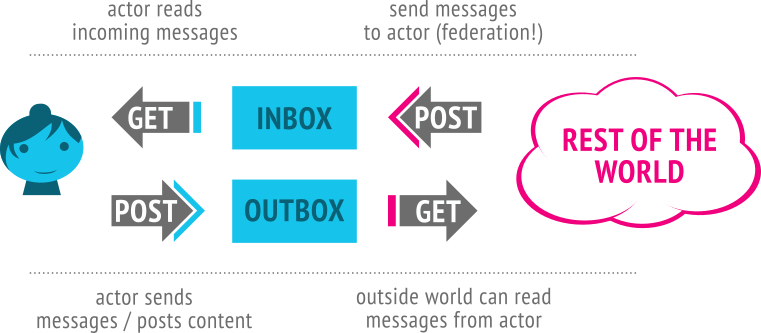
Enter ActivityPub! ActivityPub is a decentralized social networking protocol based on the ActivityStreams 2.0 data format. ActivityPub is an official W3C recommended standard published by the W3C Social Web Working Group. It provides a client to server API for creating, updating and deleting content, as well as a federated server to server API for delivering notifications and subscribing to content.
Sounds exciting? Dive in!
Specification
==> Latest published version <==
==> Latest editor's draft <==
To understand the whole ActivityPub stack as it is commonly implemented, also read:
Hey, Implementers!
We’re so stoked to have you implementing ActivityPub! To make sure ActivityPub implementations work together, we have:
Places for developer discussion:
In English:
- Discussion forums: Discourse with ActivityPub support
- Discussion forums: NodeBB with ActivityPub support
- Developer chat: Matrix
- Developer and standardization chat: IRC channel #social
Beyond English:
- In Catalan: agora.fedi.cat
- In Korean: fedidev.kr
Implementations and usage:
- FediDB: Fediverse Network Stats
- Fediverse Observer: Fediverse Network Stats
- The Federation: Fediverse Network Stats
Documentation:
- Guide for new ActivityPub implementers: Community edited and unofficial, but useful!
- Evan Prodromou: ActivityPub: Book published by O’Reilly
- ActivityPub Primer: Community-edited Wiki
- Understanding ActivityPub: Blog post by Sebastian Jambor
- How to make friends and verify requests. Implementing an ActivityPub inbox: Blog post by Eugen Rochko from the Mastodon project
- FediDevs.org: Developer documentation and community
- SocialDocs: Comprehensive developer resource for ActivityPub, Mastodon, and the Fediverse
Interactive exploration:
- ActivityPub.academy: A modified Mastodon instance for interactive protocol exploration
- httpsig.org: Try out HTTP signatures (RFC 9421) interactively
- Fediverse Schema Observatory: tracks the types and shapes of data exchanged between ActivityPub servers
Libraries:
- Fedify: TypeScript federation framework
- Fedipub: Engine that brings ActivityPub to Ruby on Rails applications
Testing:
- activitypub-testing: Implementation Guide
- FediTest: Testing distributed, heterogeneous systems with complex protocols such as the Fediverse.
- BrowserPub: A browser for exploring ActivityPub and the fediverse.
News:
- Connected Places: Newsletter about the open social web
- … and see below!
Events:
- Open Social Web Events: curated by FediForum
Ongoing standardization work:
- SocialCG: W3C Community Group that advances the federated social web including ActivityPub
- SocialWG: W3C Working Group, re-chartered in 2026, that will produce the next revision of the ActivityPub standard
Other resources:
- Delightful fediverse clients: Curated list of module and desktop apps for accessing the ActivityPub network
- Delightful fediverse experience: Curated list of decentralized social networking software based on ActivityPub
- Delightful fediverse development: Curated list of resources for developers creating software based on ActivityPub
- FediForum Connect: Curated list of open social web products and services for organizations, communities and creators
ActivityPub News
About this Site
This site is maintained by the Web Task Force of the Social Community Group in the W3C, the current steward of the ActivityPub stack of standards.
To learn more about the SocialCG and how to participate, go to its home page.
To contribute to this website, come to a Task Force meeting (see SocialCG calendar) or submit an issue or pull request on Github.